Handbills and flyers – which are synonymous – were always made out of paper, not cardboard.  It would be easy to assume that handbills were produced when the promoter didn’t want to pay for more-expensive posters. That may have been true sometimes, but much of the time, both posters and handbills were used simultaneously.  The posters were put up around town – or “posted” - on telephone poles, fences, store windows or anywhere they’d be seen.  Handbills were sometimes posted, too, but their size was more conducive to being stacked on countertops or any public place with appropriate foot traffic.  Posters were made to be observed, not taken; handbills were designed to be taken away by potential customers, one at a time.


A veteran of this hobby once told me that he considers 11x17” the smallest size that qualifies as a “poster.”  Anything smaller is a handbill or flyer – granted, a large one if it falls between 8x10” and 11x17” in size.  Although not a hard and fast rule, that definition sounds as reasonable as anything I’ve heard.


To my mind, handbills need to be blank on the back side to carry this classification.  This plays into the definition of being “small posters” – again, in the category of being posted somewhere - which renders the backside worthless real estate. 


What bothers me is when any paper item listing or discussing upcoming concerts is called a handbill or flyer by some dealers, perhaps wanting to artificially bump up the importance, and therefore value, of their piece.  To me, there’s a huge difference between printed matter that’s folded up and mailed, and a small poster printed up to be displayed in public.  I’ve even seen radio station surveys labeled as “handbills” in auctions.  It’s all wishful thinking, but then, there are no rulebooks yet which define these items in strict terms.  Perhaps these postercentral.com definitions will serve as a start.


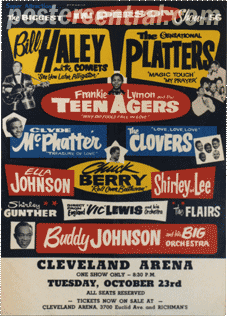
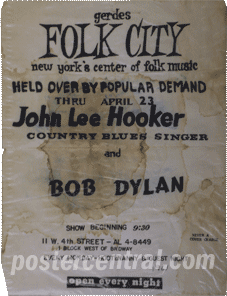
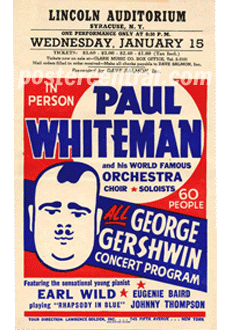
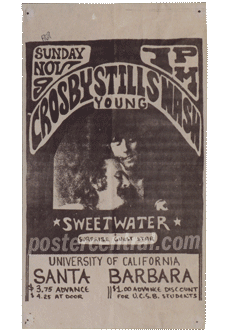
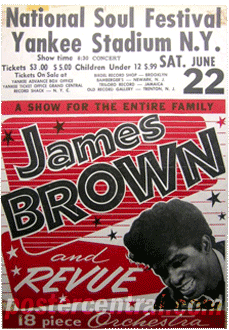
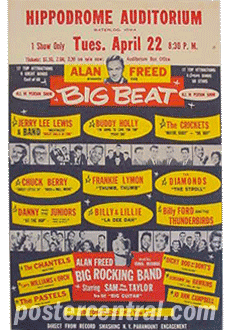
Pictured: John Lee Hooker and Bob Dylan at Gerde’s Folk City in 1961.  Helen Shapiro and The Beatles in 1963.  Freddy Martin, Shecky Greene and Elvis Presley in Las Vegas in 1956.  Crosby, Stills, Nash, Young in Santa Barbara, CA Calif. California in 1969.  James Brown at Yankee Stadium in 1968.  Paul Whiteman in Syracuse, NY in 1947.  A 1956 rare, collectible rock ’n’ roll handbill / flyer for the Biggest In-Person Show of ’56 (1956) featuring Bill Haley and His Comets, Chuck Berry, Frankie Lymon and the Teenagers, the Platters, Clyde McPhatter, Ella Johnson, Shirley & Lee, the Clovers, Vic Lewis, Buddy Johnson and his Big Orchestra, the Flairs, Shirley Gunther.  And Chuck Berry, Buddy Holly and the Crickets, Jerry Lee Lewis and Alan Freed in Cincinnati, OH Ohio in 1958. 


Cash for your stuff – talk with Pete Howard, the world’s number one authority on old, rare, cardboard, boxing-style, vintage, collectable, collectible concert posters / window cards / broadsides.


Also pictured: Sweetwater, Frankie Lymon, the Diamonds, Danny and the Juniors, Billy & Lillie, Billy Ford and the Thunderbirds, the Chantels, Larry Williams, the Pastels, Sam the man Taylor, Dicky Doo and the Dont’s, Screamin’ Jay Hawkins, Jo Ann Campbell, Alan Freed Big Rocking Band, Kestrels, Honeys, Red Price Band, Dave Allen, Danny Williams, Kenny Lynch.

r